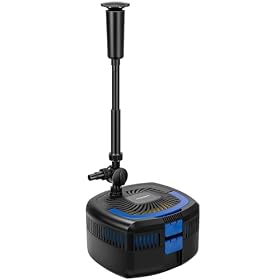
A spare pond pump can restore circulation quickly after storm debris, flooding, or pump failure. Here is how to choose a compatible backup and store it so it is ready when needed.
What do you need help with?
Open an answer, or tell us what we should cover next.
Answered in this guide
Buy a compatible spare pond pump before storm season
Use the existing pump’s type, flow rating, installation details, and connections as the starting point for choosing a backup that can replace it when needed.
Compare submersible and external pumps by how they install and operate, then choose the type that best fits your pond, pump location, and emergency replacement needs.
Request a topic and help us choose what to build next.
Estimate the total cost of a pond pump setup
Install an external pond pump vault
Requests help us prioritize the next guide. No email required.
One anonymous request per topic.
Storms can clog, damage, or interrupt a pond pump when you need circulation most. Buying a spare pond pump before storm season is sensible, but the right backup is not necessarily the largest or cheapest model. Match the replacement to your pond’s required flow, lift height, tubing, power source, and installation style—and confirm that it can handle the debris your pond typically collects.
Start with the pump you already have
Before shopping, record the information on the existing pump and its installation:
Pump type: submersible or external
Rated flow: usually listed as gallons per hour (GPH) or gallons per minute (GPM)
Maximum head height: the vertical distance the pump can move water before flow stops
Tubing size: measure the inside diameter if the label is missing
Power requirements: voltage, plug type, wattage, and whether it runs from a standard outdoor outlet
Use: waterfall, stream, filter, fountain, bottom drain, or a combination
A photo of the label, fittings, and pump compartment can make it easier to check compatibility later. Do not assume that a pump with the same advertised GPH will perform the same in your pond. Flow decreases as the water travels upward and through tubing, elbows, filters, and other restrictions.
Choose the correct flow and head height
Look at flow at operating height
The most useful specification is the pump’s flow at your system’s actual head height, not only its zero-lift or maximum flow rating. Measure from the water surface to the highest point where the pump must deliver water. Then account for friction from long tubing, narrow tubing, bends, valves, filters, and waterfalls.
If the original pump has been working properly, a backup with a similar operating flow and head capability is usually the least disruptive choice. A much weaker pump may not move enough water through the filter or waterfall. A substantially stronger pump can overflow a filter, stress fittings, increase splash, or require larger tubing and flow control.
Do not use maximum head as the expected flow
Maximum head is the point at which the pump may stop delivering useful water. It is not the height at which the pump delivers its advertised flow. Compare the manufacturer’s flow information at several heights when available, and select a model that still meets your circulation needs at the real lift height.
For a backup, it is reasonable to favor some capacity margin, but avoid oversizing without confirming that the filter, plumbing, liner, and waterfall can handle the added flow.
Product prices and availability are accurate as of the date/time indicated and are subject to change. Any price and availability information displayed on Amazon.com at the time of purchase will apply to the purchase of this product.
Decide between a submersible and external spare
Submersible pumps
A submersible pump sits in the pond, sump area, or pump vault. It is often the simplest emergency replacement because it usually needs only a safe electrical connection and compatible tubing. It can be a practical backup when the main system uses a submerged pump and there is enough room to place it securely.
Check for:
A stable base or included stand
A screened intake or debris-handling design
Compatibility with the pond’s water depth
A cord length that reaches the protected outlet without unsafe extensions
A way to keep the pump from sitting directly in sludge or loose sediment
External pumps
An external pump sits outside the pond and connects through intake and discharge plumbing. It may suit larger systems or installations designed around an external pump, but it is not always a quick substitute for a submersible model. The replacement must match the plumbing, priming arrangement, unions, valves, and electrical supply.
If the backup will replace an external pump, verify whether the system is self-priming, whether a check valve is required, and how the manufacturer specifies priming and startup. External pump installation can involve leak, flooding, and electrical hazards; follow the instructions and use a qualified professional when the setup is beyond a straightforward replacement.
Product prices and availability are accurate as of the date/time indicated and are subject to change. Any price and availability information displayed on Amazon.com at the time of purchase will apply to the purchase of this product.
Account for storm debris and dirty water
Storms can push leaves, twigs, mud, and suspended sediment into a pond. A pump intended for clean water may clog quickly in those conditions, even if its flow rating is adequate.
Look for manufacturer information about:
Solids-handling capability
Intake screen design
Maximum particle size, if specified
Ease of opening and cleaning the intake
Whether the pump is intended for continuous pond use
A finer intake screen may protect the pump but clog sooner. A more open intake may tolerate larger debris but still needs a cage, prefilter, or pump vault to keep out sticks and sludge. Do not remove protective screens unless the manufacturer specifically allows it and the installation remains safe.
Confirm tubing and fittings before the purchase
A spare is most useful when it can be connected without a trip to the hardware store. Measure the existing tubing and check whether the new pump includes a stepped hose adapter, threaded outlet, or another connection type.
Avoid reducing the outlet to a much smaller hose just to make the connection fit. Narrow tubing increases friction and can reduce actual flow. If the pump uses a threaded fitting, do not force mismatched threads together. Use the manufacturer’s recommended adapter and sealant, if any.
It can be worthwhile to store a spare length of the correct tubing, clamps rated for the application, and any pump-specific adapters with the backup pump.
Check power and storm readiness
A pond pump should be connected to an outdoor-rated, GFCI-protected circuit installed in accordance with local electrical requirements. Keep plug connections elevated and protected from standing water, while still following the pump and GFCI manufacturer’s instructions.
Before storm season, verify:
The outlet and GFCI operate correctly using the device’s test and reset controls.
The pump cord has no cuts, crushed sections, exposed conductors, or damaged plug.
The circuit is not overloaded by lights, heaters, aerators, or other equipment.
The backup pump’s electrical requirements are compatible with the outlet and controls.
Automatic timers or smart outlets will not prevent the backup from starting when needed.
Do not operate a damaged pump or bypass GFCI protection. If a breaker or GFCI repeatedly trips, disconnect the equipment and have the electrical system and pump checked by a qualified professional.
Store the spare correctly
A pump stored dry and dirty may not be ready when the main pump fails. After purchasing the backup:
Confirm that all fittings and accessories are present.
Record the pump’s flow, head, wattage, and tubing connection details.
Keep the pump indoors or in a clean, protected area where freezing temperatures will not damage it.
Store it in its original packaging or a labeled container.
Keep the manual, adapters, clamps, and spare tubing together.
Do not store the pump submerged in stagnant water unless the manufacturer specifically instructs you to do so.
If the pump has been placed in water or test-run, clean it according to the manufacturer’s instructions and allow appropriate parts to dry before long-term storage. Inspect the impeller and intake before putting it into service.
Test the backup before the storm
A brief controlled test can uncover an incompatible fitting, clogged intake, failed GFCI, or pump that cannot lift water to the required height. Test it in a safe container or in the pond installation according to the manufacturer’s instructions.
Confirm that:
Water flows in the intended direction.
The pump primes if priming is required.
Connections do not leak.
The filter or waterfall does not overflow.
The pump runs without unusual grinding, rattling, or excessive vibration.
The GFCI remains on.
Never run a pump dry unless the manufacturer explicitly states that it is designed for dry operation. A submersible pump generally needs adequate water around its intake and housing for cooling.
When a spare pump is not enough
A backup pump will not solve every storm-related problem. If the pond is filling with silt, the intake area is buried, tubing is split, or the filter is blocked, clean and inspect the system before installing the replacement. If the pond level has fallen below the safe operating level, restore the water level only in a way that is appropriate for the pond and its inhabitants.
Replace the pump rather than relying on it as an emergency backup if it has damaged insulation, a cracked housing, severe corrosion, a seized impeller, repeated electrical trips, or a leaking external seal. For an older system with brittle tubing or obsolete fittings, replacing the pump and connection parts together may be more reliable than trying to force a temporary connection.
A practical spare-pump checklist
Before buying, confirm these five points:
The backup provides suitable flow at your actual head height.
Its tubing and fittings match the existing installation.
It can handle the debris and water conditions expected after storms.
Its power requirements work with your GFCI-protected outdoor circuit.
You can store, access, and connect it without special tools or uncertain wiring.
The best storm-season spare is usually a compatible replacement that can be put into service quickly—not simply the pump with the highest advertised flow.
Should a spare pond pump be the same size as the original?
Usually, a similar pump is the safest starting point, but compare actual flow at your system’s head height rather than only the maximum GPH rating. A larger pump may overwhelm a filter or waterfall, while a smaller one may not provide enough circulation.
Can I use a submersible pump as a backup for an external pond pump?
Sometimes, but it may require different tubing, fittings, intake arrangements, and electrical planning. It is not automatically a drop-in replacement for an external pump. Verify the full installation and follow the pump manufacturer’s instructions.
How should I store a spare pond pump?
Keep it clean, protected from freezing temperatures, and stored with its manual, adapters, clamps, and compatible tubing. Do not leave it in stagnant water unless the manufacturer specifically permits that storage method.
How often should I test a spare pond pump?
Test it before storm season and after any long storage period. A brief test can reveal a blocked intake, missing adapter, failed GFCI, leak, or inadequate lift capacity before an emergency occurs.