The right pond pump for a biological filter is the one that delivers an appropriate actual flow rate through the filter after hose friction, lift, fittings, and other restrictions are accounted for. A pump’s advertised maximum flow is measured under ideal conditions and can be much higher than its output once installed.
Filters & Dust · Mon Sep 07
Matching pump flow to a biological filter
Match a pond pump to a biological filter by comparing the filter’s recommended flow with the pump’s actual output at your installation height—not the pump’s maximum flow rating.
Start with the filter’s recommended flow range
Check the biological filter’s manual, label, or manufacturer specifications first. Look for:
- Minimum and maximum recommended flow
- Maximum pump size
- Inlet and outlet sizes
- Whether the rating applies to gravity-fed or pump-fed use
- Whether the rating refers to the filter alone or the entire waterfall or circulation system
If the filter gives a recommended flow range, keep the pump’s real operating flow inside that range. Do not size the pump by matching its maximum gallons-per-hour figure to the filter rating.
A filter’s advertised pond-capacity rating is also not a direct pump-sizing instruction. Capacity depends on fish load, feeding, sunlight, water clarity goals, and the amount of biological media. Use the filter’s flow guidance whenever it is provided.
Biological filter for a pond
 VIVOHOME 1580GPH Bio Pressure Pond Filter with 13W Light for Various PondsVIVOHOME
$129.19 as of
View on Amazon VIVOHOME 2630GPH Bio Pressure Pond Filter with 13W Light for Various PondsVIVOHOME
$179.99 as of
View on Amazon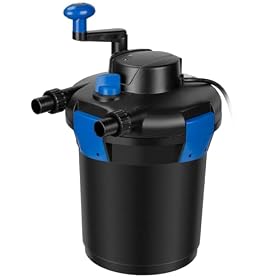 Anbull 1060GPH Bio Pressure Pond Filter with 9W Light for Outdoor PondAnbull
$94.99 as of
View on Amazon
Product prices and availability are accurate as of the date/time indicated and are subject to change. Any price and availability information displayed on Amazon.com at the time of purchase will apply to the purchase of this product.
Calculate the flow the pond needs
A common starting point is to circulate the pond’s volume about once every one to two hours, but this is only a starting point. The appropriate turnover depends on the pond’s fish load, filter design, climate, water feature, and whether the pump also supplies a skimmer or other equipment.
Use this basic calculation:
Required flow per hour = pond volume ÷ desired turnover time in hours
For example, if a pond contains 2,000 gallons and the design goal is one complete circulation every two hours:
2,000 gallons ÷ 2 hours = 1,000 gallons per hour
That result is the flow required at the pond system—not necessarily the pump’s labeled maximum output. The biological filter must also accept that flow without exceeding its own limit.
Pump for a filter system
 ANBULL All-in-One Pond Filter Fountain Kits,1370 GPH Pond Water PumpAnbull
$123.49 as of
View on Amazon
Product prices and availability are accurate as of the date/time indicated and are subject to change. Any price and availability information displayed on Amazon.com at the time of purchase will apply to the purchase of this product.
Account for head height and plumbing losses
A pump has to overcome total dynamic head, which includes more than the vertical height to the waterfall or filter outlet. It can include:
- Vertical lift from the pond surface to the filter or return point
- Long runs of tubing or pipe
- Narrow tubing
- Elbows, tees, valves, and quick-connect fittings
- Check valves and other restrictions
- Filter resistance and dirty media
- Waterfalls or spray bars
Find the pump’s flow curve rather than relying on its zero-head rating. The curve should show the expected flow at different head heights. Choose the point on the curve that is closest to your installation’s total head.
If the pump curve is unavailable, the result is less certain. Use the manufacturer’s guidance, avoid undersized tubing, and consider measuring the installed flow before finalizing the setup.
Why tubing size matters
A small hose can restrict a pump even when the pump itself is large enough. Long narrow tubing creates more friction than a short, larger-diameter run. Reducing the outlet size immediately after the pump may also reduce useful flow and increase the load on the system.
Use the filter’s specified inlet and outlet sizes where practical. Keep runs as short and straight as the layout allows, and avoid unnecessary fittings.
Larger-diameter pond tubing
 Wocloer Pond Tubing 1” × 20 Feet Black Flexible PVC Pond Hose,Garden PVC Tube -…Wocloer
$25.99 as of
View on Amazon LONGRUN Pond Tubing 1 Inch Diameter, 20.7 Feet Long Corrugated Flexible Hose Pipe with Clamps…Longrun
$28.99 as of
View on Amazon- Wocloer Corrugated Pond Tubing 1" × 10ft — Heavy-Duty Kinkproof PVC Pond Hose for Pumps,…Wocloer
$16.99 as of
View on Amazon
Product prices and availability are accurate as of the date/time indicated and are subject to change. Any price and availability information displayed on Amazon.com at the time of purchase will apply to the purchase of this product.
Compare actual pump flow with the filter limit
The final pump choice must satisfy two conditions:
- It delivers enough flow for the pond and other equipment.
- Its actual flow through the biological filter stays within the filter’s allowed range.
A pump can be powerful enough for the pond but too powerful for the filter. Excess flow may cause water to bypass media too quickly, overflow a filter chamber, disturb filter media, or exceed the capacity of the return plumbing.
A pump can also be too small. Insufficient flow may reduce circulation, leave stagnant areas, and fail to provide the filter turnover the pond requires.
If the pump serves a waterfall and biological filter at the same time, divide the flow according to the plumbing layout. A valve or bypass can send only the appropriate amount through the filter while the remaining flow serves the waterfall. Use a valve to regulate flow on the discharge side, not by restricting the pump’s intake unless the manufacturer specifically permits it.
Pump-fed and gravity-fed filters are different
Pump-fed biological filters
In a pump-fed setup, the pump pushes water into the filter. The pump’s actual output and the filter’s maximum input flow are the main concerns. The filter must have enough capacity to receive the incoming water without leaking or overflowing.
Install an overflow path or return route where the filter manufacturer recommends one. A blocked outlet can cause water to spill from the filter or drain the pond.
Gravity-fed biological filters
In a gravity-fed system, water moves from the pond or bottom drain into the filter before a pump returns it to the pond. The filter and pipework must be designed to supply the pump with enough water. A pump that removes water faster than the gravity side can replenish it may cause the pump chamber to run dry.
For these systems, follow the filter manufacturer’s requirements for pipe diameter, water level, pump location, and safe operating flow. Do not assume that a pump’s rated output is suitable simply because the filter’s maximum flow appears higher.
How to choose between two pump sizes
When two pumps appear suitable, compare their flow at the actual operating head and consider these factors:
- The filter’s minimum and maximum flow
- Whether the pump will also supply a waterfall, UV clarifier, or skimmer
- Seasonal changes in water level
- How much flow the return plumbing can handle
- Whether a controllable-speed pump allows adjustment
- Energy use at the required operating point
- The availability of a bypass or flow-control valve
A slightly larger controllable pump may provide useful flexibility, but only if the filter, tubing, and return path can safely handle the possible flow. A fixed-speed pump that is substantially oversized may waste energy and require throttling or a bypass.
Common sizing mistakes
Matching maximum pump GPH to the filter rating
A pump labeled for a particular flow may produce that flow only at zero lift and with no plumbing restriction. Compare the filter rating with the pump’s flow at the operating head instead.
Ignoring the filter’s minimum flow
Some filters need a minimum flow to distribute water across the media or keep internal chambers operating correctly. A pump that is too small may not perform as intended, even if it does not exceed the maximum.
Using undersized tubing
Small tubing can turn an apparently suitable pump into a weak-flow system. It also makes the pump work against greater resistance.
Forgetting other equipment
A UV clarifier, check valve, spray bar, waterfall, or long return line can change the flow reaching the filter. Include all restrictions in the system assessment.
Treating a dirty filter as a pump-sizing problem
Biological media and mechanical prefilters naturally collect debris. If flow declines over time, inspect and clean the mechanical stage according to the filter instructions before replacing the pump.
A practical setup and adjustment process
- Measure or estimate the pond volume.
- Choose a reasonable turnover goal for the pond and fish load.
- Read the biological filter’s minimum and maximum flow requirements.
- Estimate total head, including vertical lift and plumbing resistance.
- Select a pump using its flow curve at that head.
- Match the tubing to the filter and pump connections where possible.
- Install valves or a bypass if the system needs adjustable flow.
- Start the pump and check water level, filter chambers, outlets, and return flow.
- Adjust the flow gradually while staying within the filter manufacturer’s limits.
- Recheck the system after the filter has collected debris and after the pond water level changes.
Never allow a pump to run dry. Use the manufacturer’s instructions for priming, electrical protection, grounding, and placement. Outdoor pond equipment should be connected through appropriate ground-fault protection, and electrical work should be handled by a qualified professional where required.
When a different pump or filter is the better solution
Replace or change the pump when its flow at the required head is below the filter’s minimum and cannot meet the pond’s circulation needs. A replacement pump is also reasonable when the existing pump is noisy, repeatedly overheats, leaks, or has a damaged power cord or housing.
Choose a larger filter instead when the current filter cannot safely accept the flow needed by the pond. Do not solve an undersized filter by forcing more water through it. If the pump exceeds the filter’s maximum flow, use a compatible bypass or select a pump that fits the filter and plumbing without unsafe restriction.
FAQ
Should a pond pump be stronger than the biological filter’s maximum flow?
No. The pump’s actual flow through the filter should remain at or below the filter manufacturer’s maximum. If more total pond circulation is needed, use a properly sized bypass, a separate circuit, or a larger filter.
Does a pump’s advertised GPH equal its flow through the filter?
Usually not. Advertised maximum flow is commonly measured with little or no lift and minimal restriction. Vertical height, tubing, fittings, valves, check valves, and the filter itself reduce the flow.
How often should pond water pass through a biological filter?
A common starting point is one pond turnover every one to two hours, but the appropriate rate depends on pond volume, fish load, filter design, climate, and the manufacturer’s flow recommendations.
Can I restrict an oversized pond pump with a valve?
A discharge-side valve or bypass can often reduce or redirect flow, but follow the pump manufacturer’s instructions. Do not restrict the pump intake unless specifically allowed, and never operate the pump dry.
What should I check if flow through the biological filter decreases?
Check the mechanical prefilter and filter media for debris, inspect the hose for kinks or clogs, examine seals and connections for leaks, confirm water levels and pump placement, and inspect the impeller last. Disconnect power before servicing the pump.