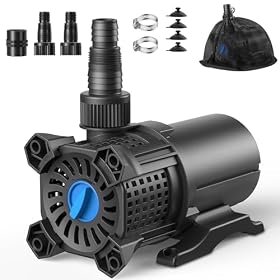
Solar pond pumps can simplify installation and avoid grid electricity, while corded pumps provide steadier flow and better support for filtration or continuous circulation. The right choice depends on your pond’s location, required flow, runtime, and tolerance for weather-related interruptions.
What do you need help with?
Open an answer, or tell us what we should cover next.
Answered in this guide
See when a solar pond pump is the better fit
A solar pump suits ponds far from a safe outlet or projects where extending electrical power is undesirable. It works best when daylight-only operation and weather-related flow changes are acceptable.
Compare pump flow, runtime, head, and tubing needs
Compare flow at the actual lift, expected runtime, head height, and tubing restrictions rather than relying only on maximum flow. These specifications show whether the pump can deliver useful circulation in the installed pond.
Start by checking the system in order, including the intake and filter, then look for restrictions or installation conditions that reduce flow below the pump’s rated performance.
Request a topic and help us choose what to build next.
Estimate the total cost of a pond pump setup
Size a pond pump for a filter, waterfall, or pond
Requests help us prioritize the next guide. No email required.
One anonymous request per topic.
Solar pond pumps are convenient where running electrical cable is difficult, but their output and runtime depend on sunlight unless they include battery storage. Corded pond pumps usually provide steadier, more predictable circulation and are the better choice for filtration, waterfalls, and ponds that need continuous operation. Choose based on the pump’s required flow, head height, runtime, installation conditions, and electrical safety—not just the advertised wattage.
Solar pond pump versus corded pump at a glance
Consideration
Solar pond pump
Corded pond pump
Power source
Solar panel, sometimes with a battery
Household electrical outlet or suitable outdoor circuit
Flow consistency
Varies with sunlight and battery charge
Usually more consistent while powered
Installation
No underground power cable, but the panel needs suitable placement
Requires safe access to an outdoor electrical supply
Best for
Small fountains, decorative features, and remote locations
Filtration, waterfalls, aeration, and continuous circulation
Nighttime operation
Only if supported by a charged battery or another power source
Generally available continuously when the circuit is on
Weather dependence
High unless battery capacity and panel output are sufficient
Lower, although outdoor electrical equipment still needs protection
Maintenance
Pump, intake, panel, wiring, and battery if included
Pump, intake, cord, outlet, and protective electrical devices
Choose a solar pond pump when installation is the main problem
A solar pump makes sense when the pond is far from a safe electrical outlet or when you want to avoid extending power to the water feature. It can be a practical option for a small fountain, birdbath-style feature, container pond, or decorative circulation where occasional low flow is acceptable.
Solar is also useful when you want to avoid adding regular electricity consumption. However, the pump is only as dependable as the complete solar system. The panel needs adequate direct sunlight, and trees, buildings, seasonal sun angles, cloud cover, dirt, and shading can reduce output.
Check whether the kit includes a battery. A panel-only system may stop or weaken when sunlight falls below the required level. A battery can extend operation into the evening, but nighttime runtime depends on battery capacity, pump power draw, charging conditions, and the pump’s control settings.
Solar may be a poor fit if the pond requires reliable overnight circulation, a strong waterfall, or continuous filtration. Reduced flow can affect water movement, oxygenation, and filter performance.
Product prices and availability are accurate as of the date/time indicated and are subject to change. Any price and availability information displayed on Amazon.com at the time of purchase will apply to the purchase of this product.
Choose a corded pond pump when steady operation matters
A corded pump is usually the safer choice for a pond filter, UV clarifier, waterfall, stream, or other feature that needs predictable circulation. It can run during cloudy weather and after sunset as long as the power supply is available and the pump is correctly sized.
Corded pumps also offer more flexibility when selecting flow and head performance. A pump must overcome the vertical lift and resistance caused by tubing, elbows, filters, valves, and spillways. A pump that looks adequate based only on its maximum flow may deliver much less water at the actual installation height.
The tradeoff is installation. Outdoor pond equipment should be connected according to the manufacturer’s instructions and applicable electrical requirements. Use an appropriately protected outdoor circuit and ground-fault protection where required. Keep plugs and connections away from standing water, and do not bury or modify a power cord unless the manufacturer and local requirements specifically allow it. Ask a qualified electrician for help if the circuit, outlet, or wiring is uncertain.
Product prices and availability are accurate as of the date/time indicated and are subject to change. Any price and availability information displayed on Amazon.com at the time of purchase will apply to the purchase of this product.
Compare the pump’s actual job, not just the power source
For a decorative fountain
Solar is often suitable if the fountain only needs to run during daylight and some variation in spray height is acceptable. A corded pump is better if you want the fountain to operate on a schedule or maintain a similar display throughout the day and night.
For a waterfall or stream
Corded power is generally more practical. Waterfalls need enough flow at the required lift, and a solar pump may slow noticeably during passing clouds or late afternoon. If you choose solar, verify the pump’s stated flow at the intended lift rather than relying on its free-flow rating.
For pond filtration
Use a pump that can maintain the filter manufacturer’s required flow after accounting for lift and plumbing resistance. A corded pump is normally the more dependable option for biological filters, pressure filters, and UV clarifiers because interrupted or weak circulation can reduce treatment performance.
For aeration or oxygen movement
Solar can work for daytime aeration in a small pond, but it may not provide dependable overnight oxygen movement unless the system has suitable battery storage. If fish depend on continuous aeration, consider a more consistent power source and follow the equipment manufacturer’s operating guidance.
Product prices and availability are accurate as of the date/time indicated and are subject to change. Any price and availability information displayed on Amazon.com at the time of purchase will apply to the purchase of this product.
Compare specifications that affect the decision
Maximum flow and flow at lift
Maximum flow is commonly measured with little or no elevation and minimal plumbing resistance. It does not represent the flow you will necessarily get in the pond.
Measure or estimate the vertical distance from the pump’s water level to the outlet, then account for tubing length, fittings, valves, filters, and the feature itself. Use a pump curve or performance table when available. For solar pumps, consider that the listed performance may depend on strong sunlight or a fully charged battery.
Runtime
Ask how many hours per day the feature must operate. A solar pump with no battery may be limited to daylight. A battery-equipped kit may run longer, but the usable runtime can change with weather and seasonal sunlight.
A corded pump is more suitable when the pond needs circulation overnight or on a fixed schedule. A timer can control a corded pump if intermittent operation is acceptable and the setup is approved for outdoor use.
Head height
Head height is the vertical lift the pump must overcome. A pump rated for high free-flow volume may perform poorly when lifting water to a raised waterfall or filter inlet. Compare the pump’s performance at your required head, not only its headline flow figure.
Tubing size and restrictions
Narrow tubing, sharp bends, clogged filters, and restrictive fittings reduce flow. Use tubing compatible with the pump outlet and keep the route as short and smooth as practical. Do not assume that a larger pump will fix undersized or obstructed plumbing.
Intake protection
A pump cage, intake screen, or suitable prefilter can help keep leaves, sludge, and larger debris away from the impeller. The protection must still be cleaned regularly because a blocked intake can reduce flow and make the pump appear undersized.
Installation and maintenance differences
Solar pump maintenance
Keep the solar panel clean and positioned where it receives the intended sunlight. Check panel brackets after wind or storms, and inspect the cable for damage. If the system includes a battery, follow the manufacturer’s charging, storage, and replacement instructions.
Remove and clean the pump intake and impeller as needed. Algae, sediment, and small debris can reduce output even when the panel is working normally.
Corded pump maintenance
Inspect the intake, impeller chamber, tubing, cord, plug, and outdoor connection. Keep the pump submerged if it is designed for submersible operation, and never run it dry unless the manufacturer explicitly permits that use.
A corded pump should be connected through the required protective electrical equipment. If a breaker or ground-fault device repeatedly trips, unplug the equipment and stop using it until the cause is identified. Do not repeatedly reset the protection without checking the pump, cord, outlet, and surrounding conditions.
Which option costs less to operate?
A solar pump does not draw electricity from the household supply, but the complete system may include a panel, controller, battery, mounting hardware, and replacement parts. Battery replacement can become an important ownership cost.
A corded pump adds ongoing electrical consumption. Its operating cost depends on power draw, daily runtime, and the local electricity rate. To estimate usage, multiply the pump’s electrical input in kilowatts by the hours it runs, then by your electricity rate. Use the manufacturer’s electrical rating rather than guessing from the pump’s size.
Purchase cost alone does not determine value. A solar pump may cost less to install in a remote area, while a corded pump may be more economical when reliable filtration or long daily runtime is required.
A practical decision rule
Choose a solar pond pump when:
The feature is small or primarily decorative.
The pond is remote from a safe electrical supply.
Daylight-only or weather-dependent operation is acceptable.
You can place the panel in an adequately sunny location.
You do not need guaranteed flow for filtration or overnight aeration.
Choose a corded pond pump when:
The pump must run reliably through cloudy weather and at night.
You are powering a filter, UV clarifier, waterfall, or stream.
The installation needs predictable flow at a specific head height.
The pond contains fish that depend on consistent circulation or aeration.
A safe, properly protected outdoor electrical supply is available.
A hybrid setup can also be reasonable: use a corded pump for essential filtration and circulation, then add a solar fountain or solar aerator for a separate decorative feature. This avoids making a weather-dependent device responsible for the pond’s critical water movement.
If the pump does not deliver the expected flow
Check the system in this order:
Clean the intake and filter. Remove leaves, algae, sludge, and debris from the pump screen, prefilter, or cage. Clean the impeller according to the instructions.
Inspect the tubing. Look for kinks, crushed sections, blockages, and an outlet that is too narrow for the installation.
Check for leaks. A loose connection or split tube can reduce water reaching the waterfall or filter.
Confirm the setup. Recheck the pump’s water depth, outlet direction, lift height, valve position, and whether it is suitable for submerged or external use.
Account for the power source. Solar output may be low because of shade, cloud cover, dirty panels, a weak battery, or a loose cable. For a corded pump, check that the protective device has not tripped—but do not bypass or defeat electrical protection.
Consider wear or electrical failure. If the pump is clean, correctly installed, and receiving the required power but still has weak or no output, the impeller, controller, motor, or cord may need service or replacement.
Replace a low-cost solar pump or corded pump when a compatible replacement part is unavailable, repair costs approach the cost of a new unit, or the pump has suffered water intrusion, damaged insulation, repeated overheating, or persistent electrical faults. For any damaged power cord or questionable electrical component, stop using the pump and defer to the manufacturer or a qualified professional.
FAQ
Is a solar pond pump better than a corded pump?
Neither is universally better. Solar pumps are useful for small decorative features and locations without convenient electrical power. Corded pumps are generally better for dependable circulation, filtration, waterfalls, and overnight operation.
Will a solar pond pump run at night?
Only if it has a battery or another form of stored energy. A panel-only pump normally depends on available sunlight and may stop or lose flow as light levels fall.
Can a solar pond pump run a filter?
It can if its flow remains sufficient at the required lift and the system provides adequate runtime. For filtration that must operate reliably through clouds and overnight, a corded pump is usually the more dependable choice.
Do corded pond pumps use a lot of electricity?
Consumption depends on the pump’s electrical input and how long it runs. Estimate usage from the manufacturer’s wattage, daily operating hours, and local electricity rate rather than from the pump’s physical size.
Why is my solar pond pump weak on a sunny day?
Check for panel shade or dirt, a loose cable, a low battery, a clogged intake, restricted tubing, excessive lift, or a blocked fountain outlet. Strong sunlight at one time of day does not guarantee that the panel receives the same output throughout the day.